






Ask a service manager how the team is doing, and you’ll often get a number back: calls taken, tickets closed, or how long each call lasts. These are customer service metrics, and they’re easy to track. But they only show how busy your team was. They don’t show whether customers left happy.
Here’s the good news. A few simple numbers can tell you if customers will come back, and your team can improve every one of them with coaching.
In this post, we’ll cover which numbers to watch, which ones to ignore, and how to use them to guide your training.
Why the Right Customer Service Metrics Matter
Gartner research makes the business case plainly. In a 2020 study, Gartner found that 61% of customers who had a low-effort service experience stayed with the company, compared with 37% of those who had a high-effort one. Gartner’s analysts also pointed out that most people buy because of the product, but leave because of service failures.
There’s a people side to this, too. Gallup’s 2024 Q12 meta-analysis, which covers more than 180,000 teams, found that the most engaged teams had 10% higher customer loyalty than the least engaged. How your reps feel about their work tends to show up in how customers feel about you.
Activity Metrics vs. Outcome Metrics
Nearly every number on a service dashboard falls into one of two buckets.
Activity metrics measure what your team did: calls answered, emails sent, average handle time, tickets closed per shift. Your phone system or help desk spits these out automatically, which is why they dominate most reports.
Outcome metrics measure what happened for the customer. Was the issue fixed? Were they satisfied? How hard did they have to work to get there?
Most teams track activity because it’s free. Outcome metrics take a little setup, usually a one-question survey or a tag in your ticketing system. That extra step pays off, because outcomes are what customers remember and what your leadership team actually cares about.
Three Customer Service KPIs That Tell You Something Useful
If you add only three outcome metrics this quarter, make it these.
1. First Contact Resolution (FCR)
First contact resolution is the share of issues solved on the customer’s first call, chat, or email, with no follow-up needed. It’s one of the clearest signals of whether your reps have the knowledge and authority to help.
When FCR drops, listen to the calls behind it. Are reps transferring too fast? Promising callbacks they can’t keep? Missing the second question the customer never got to ask? We dig into this in our article on how first-call resolution transforms customer experience.
Phrases that protect FCR:
“Before we hang up, is there anything else on your account I can help with today?”
“Let’s make sure this is fully fixed. Can you try logging in while I’m still on the line?”
“I’ll stay on while I transfer you and explain the situation, so you won’t have to repeat it.”
2. Customer Satisfaction Score (CSAT)
CSAT is the familiar one-question survey: “How satisfied were you with your experience today?” usually on a 1 to 5 scale. It’s quick, customers understand it, and it tells you how a specific interaction landed.
Its weakness is that it’s a snapshot. A customer might give a friendly rep a 5 and still be stuck with an unresolved issue. So read CSAT next to FCR. High CSAT with low FCR often means your team is pleasant but not empowered. Low CSAT with high FCR usually points to tone, pacing, or how bad news was delivered.
The comments field is where the coaching material lives. If three customers in one week write some version of “felt rushed,” you’ve found your next team huddle topic.
3. Customer Effort Score (CES)
Customer effort score asks how easy it was to get help, for example: “How easy was it to get your issue resolved today?” Given Gartner’s findings on effort and retention, it may be the most underused number in service.
Effort hides in small moments: giving an account number twice, getting bounced between departments, or hanging up unsure of what happens next. Reps can lower effort on almost every call by being clear about next steps.
Phrases that lower effort:
“Here’s exactly what happens next: you’ll get a confirmation email within the hour.”
“I’ve noted everything, so if you call back, anyone on our team can pick this up.”
“You don’t need to do anything else on your end.”
The Metrics That Look Good on a Dashboard but Predict Nothing
Some numbers are fine to collect. They’re just poor at telling you whether customers will stay. Be careful with these:
Average handle time on its own. Shorter calls look efficient. But when reps rush to hit a target, customers call back, and FCR and effort scores slide. Use AHT for staffing plans, not for grading people.
Tickets closed or calls answered. Volume shows how busy the team was. A rep who closes 60 tickets and reopens 20 isn’t outperforming the one who closes 45 and gets them right.
Net Promoter Score in the contact center. NPS asks about the whole brand, including price and product. Gartner has argued that NPS gives service leaders little they can act on, and recommends interaction-level measures such as CSAT and customer effort instead.
Survey response counts. More responses feel like progress. Without someone reading the comments, they’re just storage.
If leadership expects these numbers, keep them in a secondary report. Just don’t build your coaching around them.
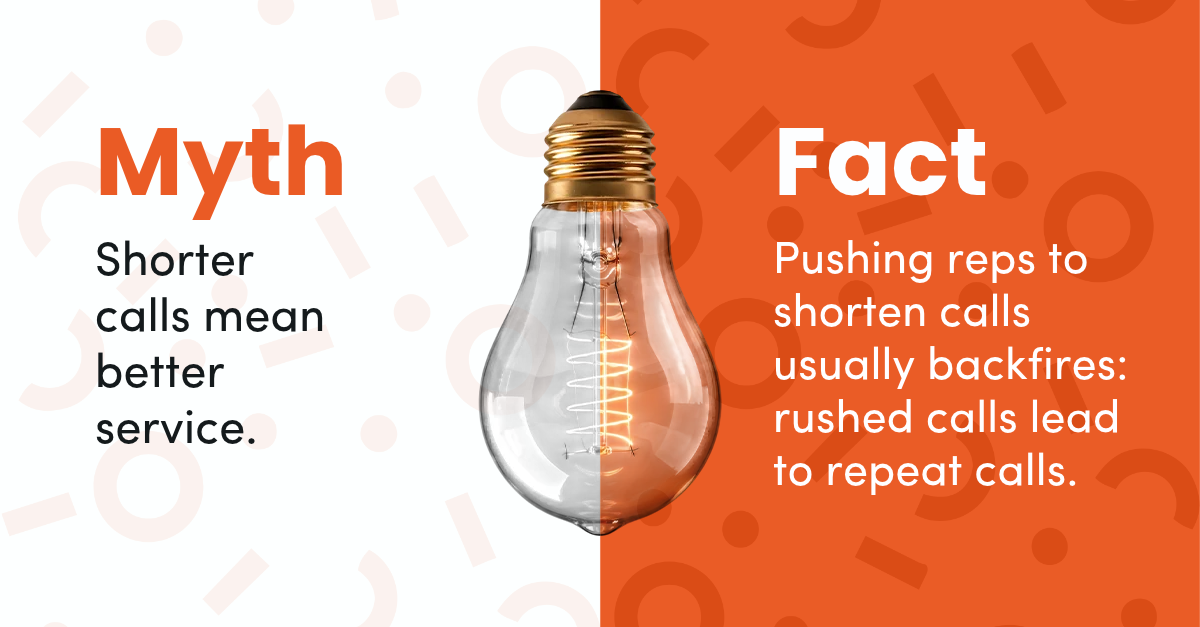
Myth, shorter calls mean better service. Fact, rushed calls lead to callbacks, so track handle time for staffing, not for grading reps.
When the Numbers Slip: Connecting Customer Service Metrics to Training
Even a well-trained team has a rough month. A new policy, a product glitch, or a busy season can push CSAT down overnight. What matters is how you read the drop.
Start by asking what kind of slip you’re looking at:
Knowledge: FCR is down and transfers are up. Reps don’t know the answer or can’t approve the fix. Update job aids and clarify escalation rules.
Skill: FCR is steady, but CSAT and effort scores are falling. Customers get answers but don’t enjoy getting them. This is where soft-skills training earns its keep: tone, listening, and how reps phrase bad news.
Pressure: Handle-time targets are tight and callbacks are climbing. Ease the target before you blame the team.
If upset callers are behind the dip, our guide to de-escalation scripts for angry customers gives reps language they can use on their next shift.
Then close the loop. Pick one metric per training topic, record a baseline, and check again 30 and 60 days later. Our article on how to measure customer service training effectiveness walks through that process step by step.
Build the Skills Behind the Numbers
Metrics show you where to coach. Your reps still need a clear model of what good sounds like. The Telephone Doctor Customer Service Collection is ServiceSkills’ flagship service training, refreshed with modern scenarios. Its short wrong-way/right-way lessons show reps the everyday habits that move CSAT, first contact resolution, and effort scores, from setting clear expectations to calming upset callers. And because every rep sees the same lessons, you get one consistent standard to coach against when the numbers shift.
Customer Service Metrics FAQ
What are the most important customer service metrics to track?
For most teams, start with three: first contact resolution, CSAT, and customer effort score. Together they tell you whether issues get solved, how customers felt, and how hard they had to work. Keep activity metrics like handle time and volume for staffing and forecasting, but focus your coaching on outcomes.
Measure What Customers Feel
The customer service metrics that matter come down to three questions: Did we fix it? Did it feel good? Was it easy? Track those, coach to them, and let the activity numbers support your staffing plan instead of steering it.
Want to see how ServiceSkills fits into your coaching plan? Book a 15-minute tour or explore the course library.